Grace To You

Grace to you and peace from God our father and the Lord Jesus Christ. Phil 1:2

Thursday, April 14, 2011

Day 3: Trip to Israel 08

We drove south along the Jordan Valley to the ancient Roman ruins at Bet She'an.

                 Jim & Carol Daniel at Bet She'an in 2009
 
It was the capitol of the Decapolis (ten cities) in ancient times. The ruins were impressive, featuring an amphitheatre, public lavatory (neccessarium!), pillars, walls, and mosaic and marble streets.

Mike Justice 2009


             Dianne Swafford between the ancient pillars in 2009.


                   Mike resting on the fallen columns.


                                  Ancient columns of Bet She'an

Mike looking at the ancient thermal bath construction.

 Main Street (Cardo) of Bet She'an with site of ancient ruins in the background.

The city was overlooked by the more ancient ruins from the days of Saul and Jonathan (where their bodies were hung on the city walls by the Philistines).


                       Ancient Amphitheatre of Beit She'an


                                                      Jordan Valley 

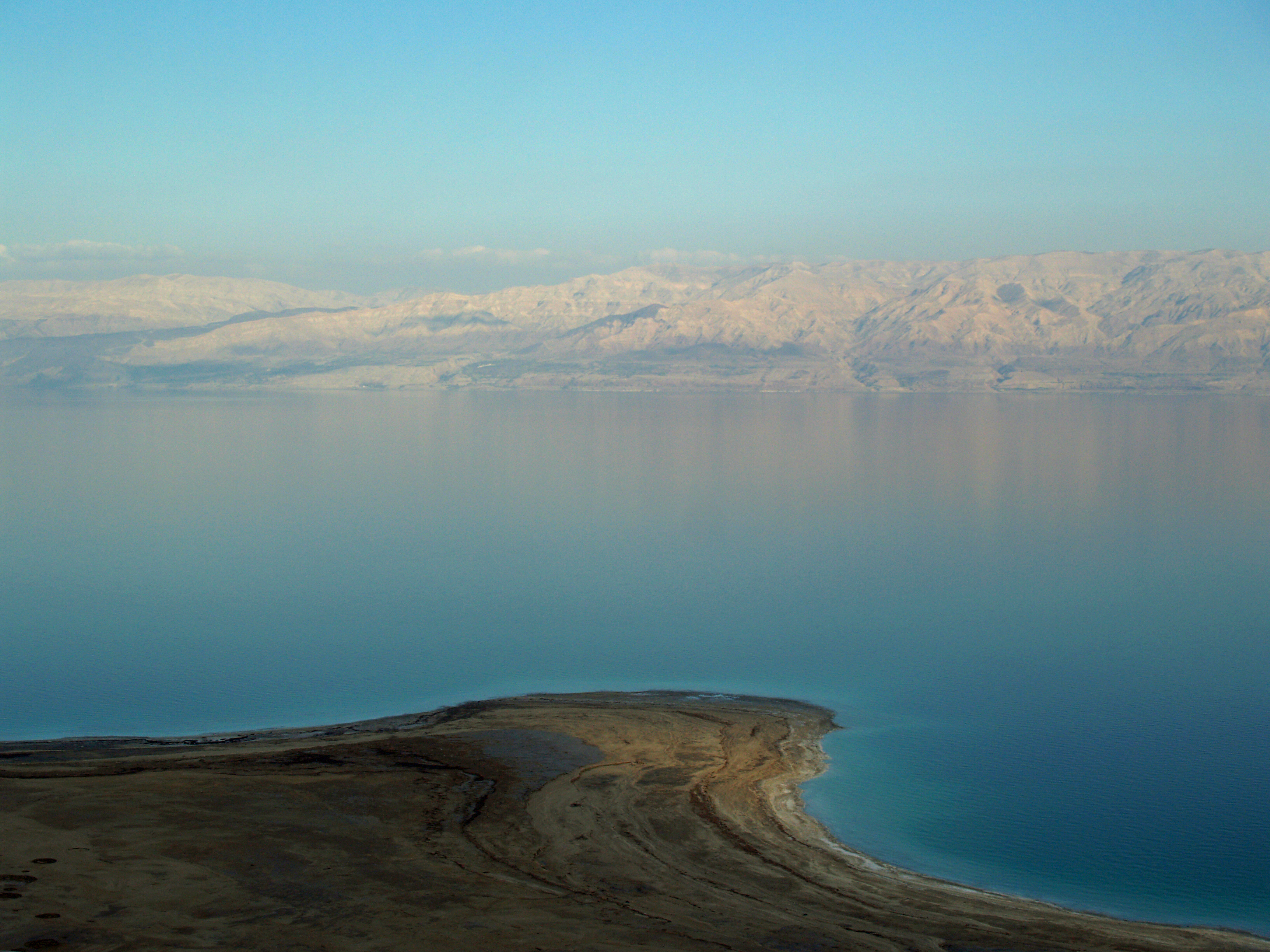
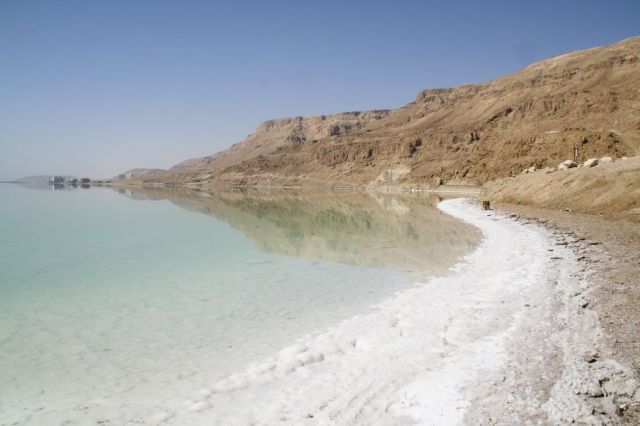
From there we drove about 90 minutes south to Qumran and Masada. The drive featured views of the Jordan Valley occupied by Jordanians on our left, as well as, Palestinian settlements in the West Bank to the right. I saw a herd of camels, a shepherdess, and some Bedouin homesteads. We drove through the desert along the Dead Sea for many miles. It was fascinating.

File:Dead Sea-18.jpg
    http://en.wikipedia.org/wiki/File:Dead_Sea-18.jpg


Mike and others were sleeping but I was leaning forward in my seat to look and soak it all in.

File:Dead Sea by David Shankbone.jpg
                   http://en.wikipedia.org/wiki/File:Dead_Sea_by_David_Shankbone.jpg
Qumran was the home of the Essenes, an ascetic religious sect who settled in the hot desert near the Dead Sea around the first century BC. They lived a communal life of self denial focused on prayer, study, meditation, poverty, charity and making copies of the scriptures. By 68 A.D. they had been massacred by the Roman legions of Titus sent to crush the Jerusalem revolt. They hid their scriptures in caves around Qumran which weren't discovered for nearly 2000 years.


         Communal living quarters at Qumran.


Steps leading down into one of the seven cisterns used to collect rainwater channelled from the mountains with an aqueduct system.

Qumran Cistern


         Area of the Dead Sea Scroll Caves near Qumran

Dead Sea Scroll in clay jar.
Most scrolls were written on papyrus and leather.
Only two were found that were written on copper. The first was found in 1947 by a Bedouin boy named Mohammed Edib. More than 900 pieces of scroll were found in more than 30 caves.  
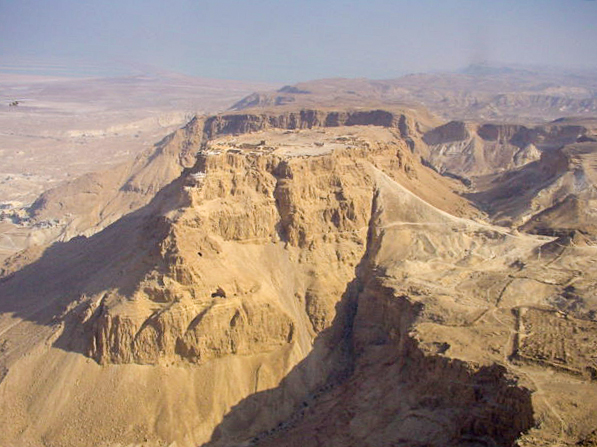

 File:Vista general de Masada.jpg
Masada: The Site of Herod's Fortress. 2000 feet above the Dead Sea. Half a mile long and 220 yards wide.

Herod built a palace in 40 B.C.on Masada.
 He built it to protect himself from the Jews in case they deposed him as King.
 Then he enhanced and fortified it to resist a possible attack by Mark Anthony.
It had 18 foot walls, 38 towers (75 ft high), store houses, cisterns, barracks, arsenals, etc.

File:Masada View from West.jpg


Masada was fascinating. We ate lunch in the ground level facilities and then took the cable car to the top.

File:Israel Aereal Ropeway Masada BW 1.JPG


 That the fortress was built in a time without mechanical assistance is incredible.

Thermal Baths at Masada

How they got all the materials up there is beyond me. He was called Herod the Great for a reason. The fortress was magnificent and the views glorious.

                                Mike and Cherel at Masada


                      Portions of the walls of Masada

                                Original Bathroom Decor


      Model of Herod's palace and fortress on Masada.


                                  View from Masada


                    Views of the Dead Sea from Masada.


I really enjoyed our visit there. I picked up a rock and a piece of pottery shard as souvenirs. I thought the pottery was 2000 years old but it’s probably from filming the movie Masada in 1981.

Masada is a Jewish Shrine because a group of Jews held the Roman 10 Legion at bay for many months in 72 A.D. When they knew they had lost, they killed themselves rather than give the Romans that satisfaction.
After Masada we stopped at an Ahava Factory (skin care and cosmetics) and then went to the Hot Springs Spa Resort on the Dead Sea. We spent an hour there. Some of the group got in the Hot Springs pool and/or the sea but Mike and I just watched– and I picked up Dead Sea salt and rocks!


                               On the shore of Dead Sea

Our final destination for the day was Jerusalem. How exciting! We drove back up through the desert along the Dead Sea and then passed groves of short Date Palms (engineered by Israelis so they can pick the dates from the ground). And I saw a some harts (miniature deer) in the desert before we reached the Jericho road turnoff toward Jerusalem.

Overlooking Old Jericho in the distance one could barely make out a Monastery built on the The Mount of Temptations. No one knows for sure, but this area is the traditional site for the cave where Jesus fasted for 40 days and the mountain site of the first and third temptations. And the summit of the mountain is supposed to be the site of the 4th temptation.

"Mount of Quarantania"

There were many Bedouin tents on the drive up to Jerusalem.


  http://en.wikipedia.org/wiki/Tent

And I was surprised by how desolate the landscape remained up to the very borders of the city.

Schlomo put on the Jerusalem song and it really set the mood for a grand entrance into the City of God. It was dark and the lights were beautiful. We checked into the Dan Panorama with a sense of excitement for the sights to come on the morrow.


Most of my original pictures got wiped out in a computer conversion so some of these are borrowed from free to use websites and some of them were taken by Dianne Swafford on her trip in 2009. Thank you, Dianne!  

Hope you enjoy.

Sunday, April 10, 2011

Day 2: Trip to Israel in 08

We got a 6:30 a.m. wake up call at the Tibereas Sheraton Hotel on our second day in Israel, so we could have breakfast before leaving at 8 o’clock, but I was already up. I had to get up at 5 or 5:30 every morning to make it on time. But, breakfast in Israel was worth it! It was a feast. They served a wonderful variety of fresh fruits, chocolate and assorted fruit pastries, bagels, scrambled eggs, olives and tuna, etc. Oh, and the juices were fresher than I’ve ever tasted in my life.


We drove beside the beautiful Sea of Galilee heading for our first destination of the day. It was so exciting seeing the areas where Jesus spent so much time with his disciples.


                                Palm trees near the Sea of Galilee


                    The Mount of Beatitudes (Blessings) Church.

One day as He saw the crowds gathering, Jesus went up on the mountainside and sat down. His disciples gathered around Him and He began to teach them. Matt 5: 1-2

                                    
Traditional site of Jesus preaching the Sermon of the Mount..


The floor plan of the church is octagonal with the eight sides representing the eight Beatitudes. Each beatitude has a stained glass window in the dome of the chapel.


Beatitudes

Blessed are the poor in spirit, for theirs is the kingdom of heaven.
Blessed are those who mourn, for they shall be comforted.
Blessed are the gentle, for they shall inherit the earth.
Blessed are those who hunger and thirst for righteousness, for they shall be satisfied.
Blessed are the merciful, for they shall receive mercy.
Blessed are the pure in heart, for they shall see God.
Blessed are the peacemakers, for they shall be called sons of God.
Blessed are those who have been persecuted for the sake of righteousness,
 for theirs is the kingdom of heaven.
Blessed are you when people insult you and persecute you,
and falsely say all kinds of evil against you because of Me.
Rejoice and be glad, for your reward in heaven is great;
 for in the same way they persecuted the prophets who were before you.
Matt 5:3-10


   A view from the Mount of Beatitudes centered on the valley between the distant mountains known as the way to Nazareth.


                           Mike and Cherel on the Mt of Beatitudes.       
      

The area where the crowds gathered. The acoustics were incredible. The sound carried naturally for a great distance.


 The town on the hillside in the distance is Magdala. Mary Magdalene's home town.


        Next we visited the Ancient Boat Museum on the Sea of Galilee.


 Remains of a 2000 year old boat which would have been in use in Jesus' time.


      Then we took a boat ride on the sea of Galilee in a fishing boat.


     Another view of the way to Nazareth.

     Imagine Jesus walking on that water and Peter too!


                     Church of the Primacy of St. Peter at Tabgha


A fisherman showed us how they throw out their weighted nets and pull them in.


Mike relaxing after sharing a devotional on the boat.


When we finished the boat ride we headed for the area of the Gadarenes for lunch. We ate Talapia which is known as St. Peter’s fish. Pretty good considering I'm not a fish person. I ate it because I wanted as full of an experience of life in Israel as possible for a quick trip.


From Gadara we traveled up to the Golan Heights.
File:Ein Fiq, Golan Heights - 20040223-03.jpg
 The pastureland on the hillsides was so rocky I wondered how those fat cows of Bashan keep from breaking their legs! 

We watched a movie about the beauties and benefits of living on the Golan Heights in spite of its strategic value to the defense of Israel.
   
Our late afternoon was spent visiting Capernaum.The city ruins are located on the northern shore of the Sea of Galilee, about two miles west of the Jordan River.  It was the hometown of Peter, Andrew, James, John and Matthew. Jesus made it the headquarters for His Galilean ministry and performed many miracles here.

 "And leaving Nazareth, He came and dwelt in Capernaum, which is by the sea, in the regions of Zebulun and Naphtali, that it might be fulfilled which was spoken by Isaiah the prophet, saying: 'The land of Zebulun and the land of Naphtali, the way of the sea, beyond the Jordan, Galilee of the Gentiles: the people who sat in darkness saw a great light, and upon those who sat in the region and shadow of death light has dawned.'" Matt 4:13-16

The climate in the area makes it abundantly fruitful. They had an aloe vera plant among the ruins that was about 4 feet high and 6 feet wide. It was incredible. The area is known for olives, figs and a variety of fruit.


Statue of Peter


      Schlomo sharing the history of the town and the synagogue.


                                    Synagogue tile.


Excavated portion of Peter's house.

"The house of St. Peter, often mentioned by the Synoptic Gospels in relation to the activity of Jesus in Capernaum, and recorded later on by pilgrims, was rediscovered in 1968 under the foundations of the octagonal church some 30 meters south of the synagogue. The history of that house where Jesus lived, can be summarized as follows: (1) the house was built in the Late Hellenistic period; (2) in the late first century A.D. it was changed into a 'domus-ecclesia', i. e. became a house for religious gatherings; (3) in the fourth century A.D. the same 'domus-ecclesia' was enlarged and was set apart from the rest of the town through an imposing enclosure wall; (4) in the second half of the fifth century A.D. an octagonal church was built upon the house of St. Peter and remained in use until the seventh century a.d.; (5) the identification of the house of St. Peter is based on the combination of archaeological data and literary sources which run side by side in a wonderful way." (Stanislao Loffreda, Recovering Capernaum, p. 51).


          Town ruins with the synagogue in the background.

 "The synagogue at Capernaum is not the one where Jesus preached, but is likely to lave been built on the same site. There is now considerable controversy over the dating of the reconstructed synagogue. Since its discovery it has been accepted as being late 2nd or early 3rd century, but the more recent discovery of coins from A.D. 383-408 embedded in the mortar suggests that the building was actually erected in the late 4th or early 5th century." (Jenny Roberts, Bible Then and Now, p. 129).


      The ruins include an oil press, a flour mill and a wine press.


More Capernaum ruins.
 
On our way back to Tiberias we visited the the Church of the Multiplication of the Loaves and the Fishes at Tabgha on the Sea of Galilee.
Church of the Multiplication 


File:Brotvermehrungskirche BW 12.JPG
Interior of the church.

File:Brotvermehrungskirche BW 3-2.JPG
Mosaic inside Church of the Multiplication


Then we visited the Church of the Primacy of  St. Peter which houses the limestone rock formation known as "the table of Christ" where Jesus is supposed to have fed his disciples breakfast after the resurrection and also where Jesus is thought to have told Peter to "feed my sheep."


File:Primatskapelle BW 2.JPG
                                   The Table of Christ

 With our guides permission, I gathered several rocks from the Galilee shoreline in front of the church as others gathered sand and even water to take home with them. And they made it through customs in Tel Aviv!


We ended a great day at the Tiberias Sheraton again and the group was taken to a nearby host hotel to eat, but I stayed in the room because I needed a break.

Let me end the day with a passage from the Sermon on the Mount.

You are the salt of the earth; but if the salt has become tasteless, how can it be made salty again? It is no longer good for anything, except to be thrown out and trampled under foot by men. You are the light of the world. A city set on a hill cannot be hidden; nor does anyone light a lamp and put it under a basket, but on the lampstand, and it gives light to all who are in the houseLet your light shine before men in such a way that they may see your good works, and glorify your Father who is in heaven. Matt 5:13-14

(I borrowed the last few pictures from "free to use" wikipedia pictures because my camera battery died.)